
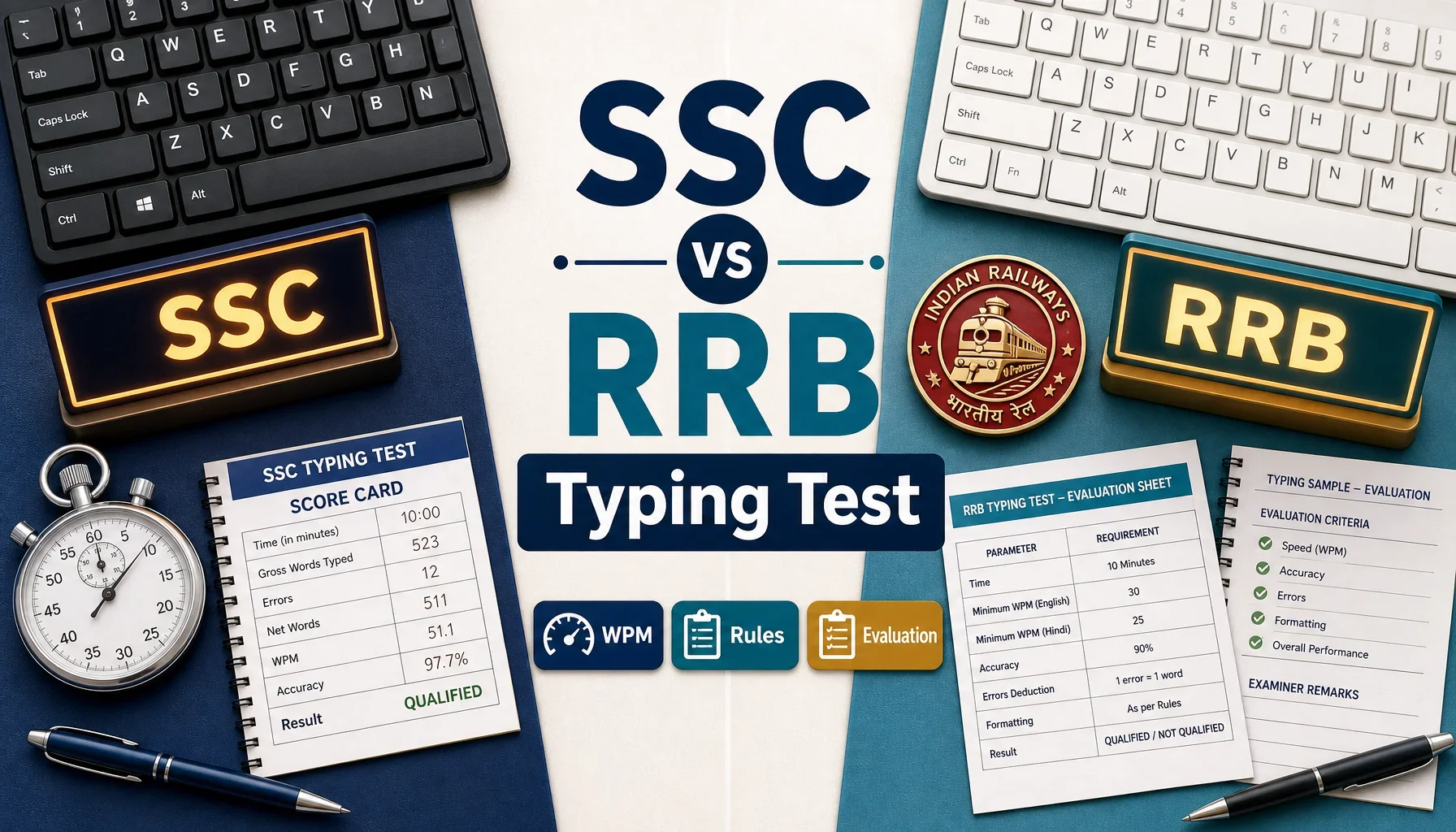
If you're preparing for a government job through the Staff Selection Commission (SSC) or the Railway Recruitment Board (RRB), chances are a typing test stands between you and your dream posting. While both examinations assess typing proficiency, the rules, speed requirements, and evaluation methods differ in ways that can catch unprepared candidates off guard. Understanding these distinctions early can save you from unpleasant surprises on test day and help you tailor your practice more effectively.
Table of Contents
In this article, we'll break down the SSC and RRB typing tests side by side—covering everything from words-per-minute (WPM) benchmarks to error tolerance and evaluation criteria—so you know exactly which standards apply to your exam.
Why Typing Tests Matter in SSC and RRB Recruitment
Many clerical and administrative government roles involve extensive data entry, correspondence, and documentation. To ensure candidates can handle these responsibilities, both SSC and RRB include a typing or skill test as a qualifying stage for specific posts. For SSC, this applies to positions like Lower Division Clerk (LDC), Data Entry Operator (DEO), and Court Clerk. For RRB, typing tests are relevant to posts such as Junior Clerk cum Typist, Senior Clerk cum Typist, and Junior Time Keeper.
It's important to note that these tests are usually qualifying in nature—meaning they don't add to your merit score, but failing them can disqualify you entirely, no matter how well you scored in the main exam.
Speed Requirements: WPM Standards Compared
The most fundamental difference between the two exams lies in the required typing speed, which also varies by language.
SSC Typing Speed
- English: 35 words per minute (approximately 10,500 key depressions per hour)
- Hindi: 30 words per minute (approximately 9,000 key depressions per hour)
For SSC Data Entry Operator posts, the requirement is often expressed differently—as a data entry speed of 8,000 key depressions per hour on a computer, tested over a duration of around 15 minutes.

RRB Typing Speed
- English: 30 words per minute
- Hindi: 25 words per minute
As you can see, RRB typically sets a slightly lower speed threshold compared to SSC. This makes the RRB typing test marginally more forgiving in terms of raw speed, though other factors like accuracy still play a crucial role.
Test Duration and Passage Length
Both exams generally provide a passage that must be typed within a fixed time frame, but the specifics differ.
SSC Test Format
In the SSC typing test, candidates are usually given a printed passage and asked to type it within 10 minutes. The passage is designed so that a candidate typing at the required speed can complete it comfortably within the allotted time. The test is conducted on a computer, and the passage may be in English or Hindi depending on the language the candidate has opted for.
RRB Test Format
The RRB typing skill test similarly involves typing a passage on a computer within 10 minutes. Candidates choose their preferred language (English or Hindi) in advance, and they must type using standard keyboard layouts. One key point for RRB Hindi typing is the use of the Krutidev or Mangal font, so candidates need to familiarize themselves with the specific font requirements mentioned in the official notification.
Evaluation and Error Tolerance
Speed alone won't get you through—accuracy is equally important. Here's where the evaluation philosophies of the two exams come into focus.
How SSC Evaluates
SSC typically follows a relatively strict evaluation model. Errors are counted, and the accuracy percentage is calculated. While SSC has, in some cycles, allowed a small margin of error, candidates are generally expected to maintain high accuracy. Full mistakes (wrong words) and half mistakes (spelling or spacing errors) are often distinguished, and the cumulative error count determines whether you pass.
How RRB Evaluates
RRB usually permits a certain percentage of errors—commonly around 5% mistakes are tolerated in the typed passage. This built-in allowance means candidates have a bit more breathing room, but exceeding the error threshold results in disqualification. As with SSC, the emphasis is on balancing speed with clean, accurate output.
Side-by-Side Summary
- English speed: SSC requires 35 WPM; RRB requires 30 WPM.
- Hindi speed: SSC requires 30 WPM; RRB requires 25 WPM.
- Nature of test: Both are qualifying in nature, not merit-based.
- Duration: Both typically allow around 10 minutes.
- Error tolerance: RRB generally allows up to ~5% errors; SSC tends to be stricter.
- Font consideration: RRB Hindi typing often specifies Krutidev/Mangal fonts.
Practical Tips for Both Exams
Regardless of which exam you're targeting, the fundamentals of effective preparation remain similar:
- Practice daily: Consistency builds muscle memory. Aim for at least 30 minutes of focused typing practice each day.
- Simulate real conditions: Use the same font, layout, and time limit as your target exam to reduce test-day anxiety.
- Prioritize accuracy first: Speed naturally improves with practice, but sloppy typing that racks up errors is harder to fix. Build a clean foundation.
- Learn the correct finger placement: Touch typing without looking at the keyboard dramatically boosts both speed and consistency.
- Practice in your chosen language: If you're opting for Hindi, get comfortable with the specific keyboard mapping well in advance.
Which Standard Applies to You?
The simplest way to determine your requirements is to read the official notification for the specific post you're applying to. SSC and RRB publish detailed guidelines outlining speed, language options, and evaluation rules for each recruitment cycle. Never rely solely on general information—requirements can be revised, and post-specific variations exist.
If you're preparing for both exams simultaneously, aim to meet the higher SSC standards. By training to type at 35 WPM in English with excellent accuracy, you'll comfortably clear the RRB threshold as well, giving yourself a safety cushion.
Conclusion
While the SSC and RRB typing tests share the same core purpose, their differences in speed requirements, error tolerance, and font specifications matter more than many candidates realize. SSC demands slightly higher speeds and stricter accuracy, whereas RRB offers a marginally gentler benchmark with a defined error allowance. By understanding which standards apply to your target post and practicing accordingly, you can walk into your typing test with confidence. Start early, focus on accuracy, and let speed follow—your government job could depend on those crucial ten minutes.
