
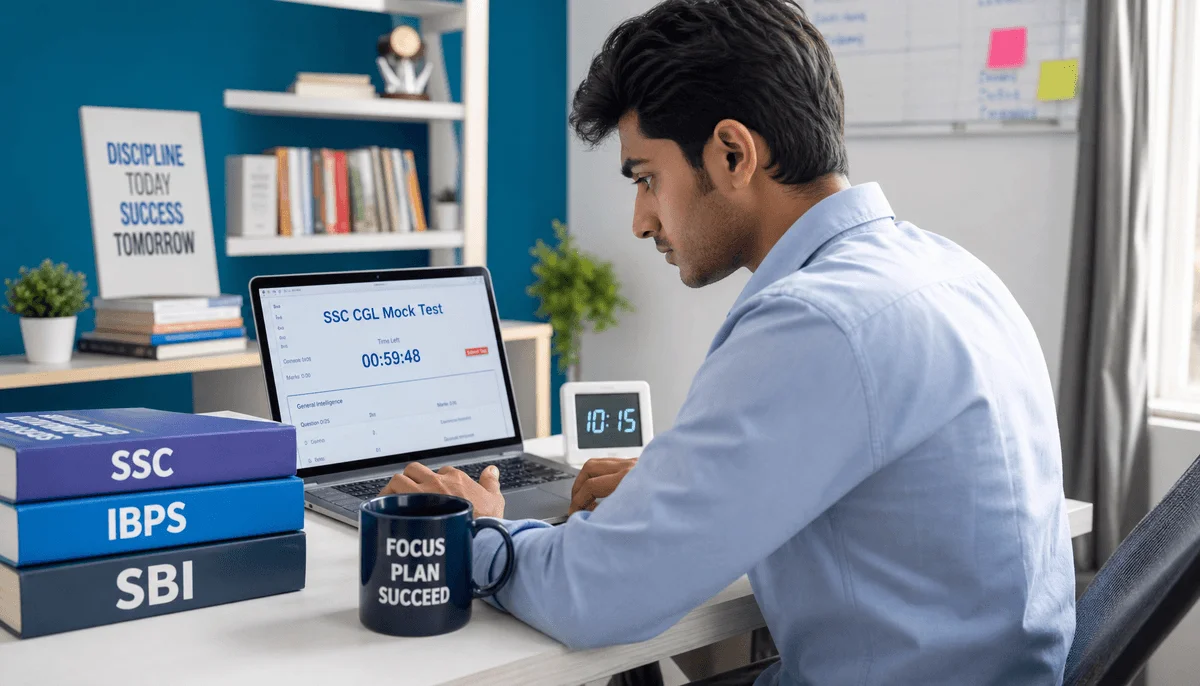
Competitive exams in India have transformed dramatically over the past decade. With lakhs of aspirants competing for a handful of vacancies in SSC, IBPS, SBI, and other banking sector recruitment drives, traditional preparation methods alone no longer guarantee success. This is where free online mock tests have emerged as a game-changing tool for serious aspirants. Whether you are targeting SSC CGL, CHSL, MTS, IBPS PO, IBPS Clerk, SBI PO, SBI Clerk, or RBI Grade B, regular mock test practice can be the difference between making the cut-off and missing it by a whisker.
Understanding the Modern Examination Landscape
The recruitment exams conducted by the Staff Selection Commission (SSC), Institute of Banking Personnel Selection (IBPS), and State Bank of India (SBI) have evolved into highly competitive, time-bound, computer-based tests. Each paper demands a unique combination of speed, accuracy, conceptual clarity, and psychological composure. A candidate may know every formula in quantitative aptitude and every rule of English grammar, yet still fail to clear the cut-off simply because they could not manage time effectively or panicked under pressure. Mock tests address precisely this gap between knowledge and performance.
Table of Contents
What Are Online Mock Tests?
An online mock test is a simulated version of the actual examination, delivered through a web platform or mobile application. It replicates the real exam interface, time limits, marking scheme, question difficulty, and section-wise structure. Free mock tests, in particular, have democratised access to quality preparation material, allowing students from small towns and modest financial backgrounds to compete on equal footing with those who can afford expensive coaching institutes.
A well-designed mock test typically includes the same number of questions, identical time duration, similar sectional divisions, accurate negative marking, and a results dashboard showing your score, percentile, time spent per question, and comparative ranking.
Why Mock Tests Are Indispensable for SSC and Banking Aspirants
Building Real Exam Temperament
There is a vast psychological difference between solving a question while sitting comfortably at your study desk and answering the same question during a high-stakes timed examination. Mock tests train your mind to function efficiently under pressure. By repeatedly exposing yourself to exam-like conditions, you gradually eliminate test anxiety, develop calmness during difficult sections, and learn to make quick decisions about which questions to attempt and which to skip.
Mastering Time Management

Banking and SSC exams are notorious for their tight time constraints. The SBI PO Prelims gives you just one hour for 100 questions across three sections, while IBPS Clerk Prelims demands the same. SSC CGL Tier 1 expects you to handle 100 questions in 60 minutes. Without dedicated practice, even brilliant students fail to complete papers. Mock tests teach you how long you can afford to spend on each question, when to move on from a tricky problem, and how to allocate the final five minutes for revision and guessing.
Identifying Strengths and Weaknesses
Every mock test serves as a diagnostic tool. After completion, the analysis reveals which topics you have mastered and which ones need urgent attention. You might discover that you score well in reading comprehension but lose marks in para-jumbles, or that you handle simplification questions quickly but struggle with data interpretation. This targeted feedback allows you to direct your study hours toward areas that will yield the maximum score improvement.
Familiarity with Exam Patterns and Question Types
The IBPS, SBI, and SSC frequently introduce new question patterns, especially in reasoning and quantitative aptitude sections. Caselets, puzzle-based reasoning, new data interpretation formats, and error-spotting in English are constantly evolving. Quality mock test platforms update their question banks regularly to reflect these changes, ensuring you walk into the examination hall without surprises.
Improving Speed and Accuracy
Speed without accuracy is dangerous because of negative marking, while accuracy without speed means leaving questions unanswered. Mock tests help you find the sweet spot. Through repeated practice, you internalize shortcut methods, Vedic math techniques, approximation strategies, and elimination tricks that significantly cut down on solving time while keeping accuracy intact.
Strategy Development for Each Section
Different sections require different approaches. In banking exams, the reasoning section often contains puzzles that should be attempted in a specific order based on difficulty. The English section rewards those who tackle vocabulary-based questions before time-consuming comprehension passages. Quantitative aptitude requires you to identify and complete simpler calculation-based questions before moving to lengthy DI sets. Mocks help you experiment with multiple strategies and finalise what works best for your individual strengths.
Boosting Confidence
Nothing beats the confidence that comes from consistently scoring well in mock tests. When you have attempted fifty or sixty full-length mocks before the actual exam, you walk into the centre with the calm certainty of an experienced player rather than the nervous energy of a debutant.
How to Use Free Online Mock Tests Effectively
Simply attempting mock tests is not enough. To extract maximum value from each test, you need to follow a structured approach.
Start by taking a diagnostic mock at the very beginning of your preparation to understand your baseline. Then build foundational concepts before jumping into full-length mocks. Once your basics are strong, attempt one full-length mock every two or three days, gradually increasing the frequency as the exam approaches. In the final month, aim for at least four to five mocks per week.
The most critical step is post-mock analysis, which should take more time than the test itself. Review every question, including those you got right, to understand whether you used the most efficient method. Categorise your mistakes into silly errors, conceptual gaps, time pressure mistakes, and genuinely difficult questions. Maintain a separate notebook for tricky questions and revisit it weekly.
Track your performance over time through a simple spreadsheet recording your scores, sectional performance, time taken, and accuracy percentage. A clear upward trend is the surest sign that your preparation is on track.
Choosing the Right Free Mock Test Platform
Several reputable platforms offer free mock tests for SSC and banking exams, including Oliveboard, Testbook, Adda247, Gradeup (now Byju's Exam Prep), PracticeMock, and Career Power. When selecting a platform, look for accurate exam pattern replication, detailed solution explanations, all-India ranking systems, sectional and topic-wise tests in addition to full-length papers, mobile compatibility for practice on the go, and regularly updated question banks reflecting current general knowledge exam trends.
Most platforms offer a few free mocks every week along with daily quizzes, which can be sufficient for budget-conscious aspirants if combined wisely across multiple platforms.
Common Mistakes to Avoid
Many aspirants treat mock tests as just another study activity rather than a strategic tool. Avoid attempting mocks without time limits, as this defeats the entire purpose. Do not skip analysis simply because the score was good or bad. Refuse to compare your scores obsessively with toppers, since percentile and consistent improvement matter more than absolute numbers. Never attempt mocks when sleep-deprived or distracted, because the data you generate will be misleading. Most importantly, do not give up after a few poor scores, since dips are part of the learning curve.
The Final Word
Free online mock tests have levelled the playing field for SSC, IBPS, SBI, and other competitive exam aspirants across India. They offer realistic exam simulation, detailed performance analytics, strategic insights, and confidence building, all without the burden of heavy coaching fees. However, mocks are tools, not magic wands. Their effectiveness depends entirely on how seriously you analyse them, how honestly you confront your weaknesses, and how consistently you integrate the lessons into your subsequent preparation.
Treat every mock test as a rehearsal for the final performance, learn from each attempt, and walk into the examination hall with the quiet confidence of someone who has already given this exam dozens of times. That mental edge, more than anything else, is what separates those who clear these prestigious exams from those who fall short
