
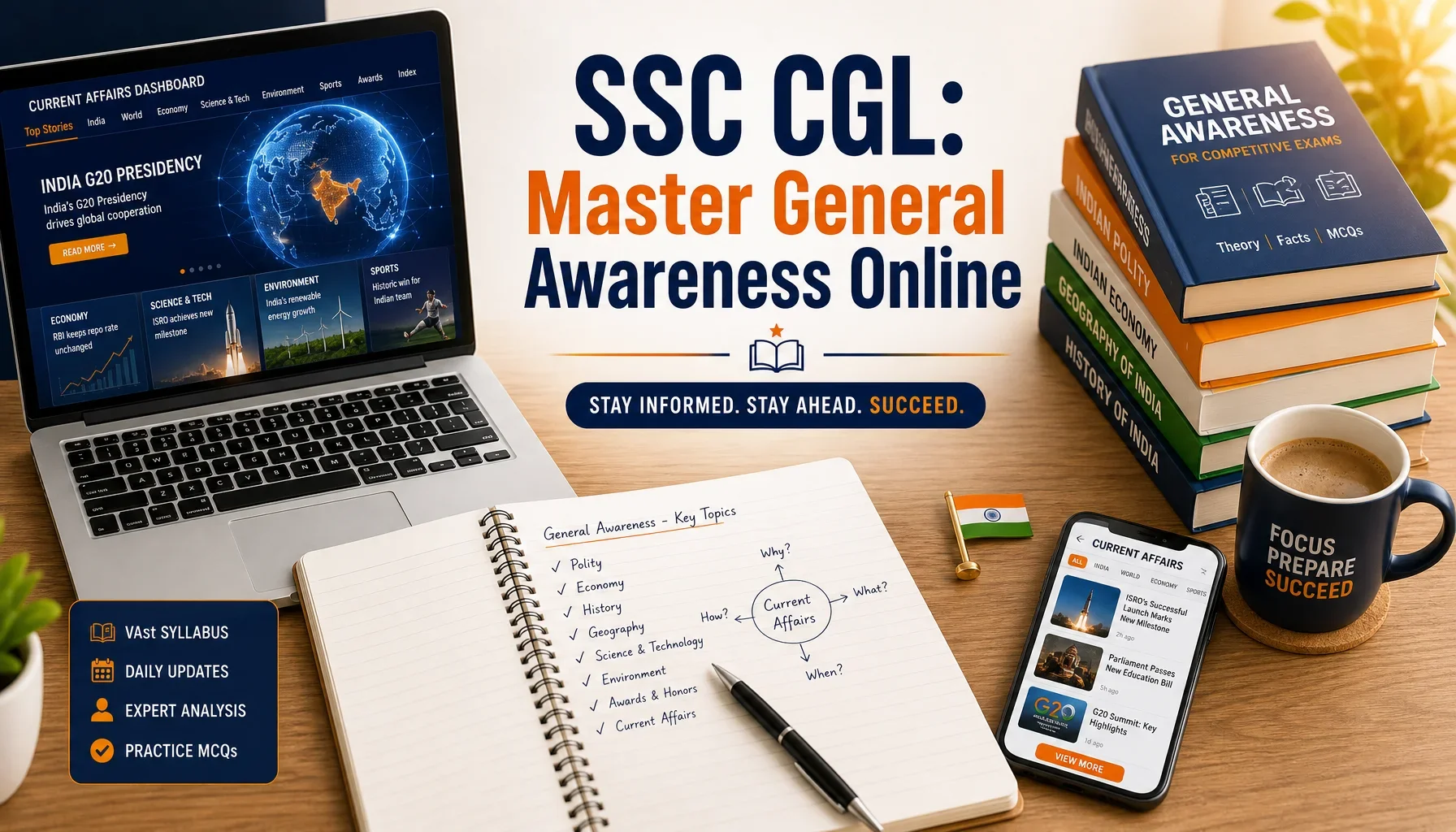
The General Awareness (GA) section of the SSC CGL exam is often the biggest game-changer. Unlike Quantitative Aptitude or Reasoning, which require lengthy calculations and step-by-step problem solving, GA questions can be answered in seconds—if you know the answer. This makes the section a high-scoring opportunity for candidates who prepare smartly. In the digital age, you no longer need to depend solely on thick GK books; a well-planned online current affairs routine combined with reliable static GK resources can help you master this section efficiently. This guide walks you through exactly how to do that.
Table of Contents
Why General Awareness Deserves Your Attention
In the SSC CGL Tier-I exam, General Awareness carries 25 questions worth 50 marks. The beauty of this section lies in its speed—correct answers require recall, not lengthy problem-solving. A strong GA score can dramatically boost your overall rank and compensate for slower sections. Moreover, GA is a recurring section across many competitive exams, so the effort you invest here has long-term returns.
The GA syllabus broadly splits into two categories:
- Static GK: History, Geography, Polity, Economics, General Science, Art & Culture, and Static awareness.
- Current Affairs: National and international events, awards, sports, appointments, schemes, and important dates.
Building a Daily Online Current Affairs Routine
Consistency beats intensity when it comes to current affairs. Reading six months of news in one sitting is impossible; reading 20 minutes daily for six months is highly effective. Here's how to structure a sustainable routine.
1. Set a Fixed Daily Time Slot
Dedicate 20–30 minutes every day to current affairs. Morning is ideal because your mind is fresh and news updates from the previous day are ready. Treat this slot as non-negotiable, just like any other study block.
2. Follow One Reliable Daily Source
Don't scatter your attention across ten different apps and websites. Pick one primary source and stick with it. Reliable options include:
- Reputed newspaper websites like The Hindu or The Indian Express for authentic reporting.
- The Press Information Bureau (PIB) website for government schemes and official announcements.
- Trusted exam-prep platforms that publish daily current affairs summaries tailored for SSC aspirants.
3. Make Concise Notes
Passive reading rarely sticks. As you read, jot down key facts—new appointments, awards, government schemes, sports winners, and important dates. Keep these notes short and bullet-based. Digital note-taking apps like Notion, Evernote, or even a simple Google Doc allow you to search and revise easily.
4. Attempt a Daily Current Affairs Quiz
Reading alone is not enough—active recall cements memory. End each session with a 10-question quiz on the day's topics. Most prep platforms and apps offer free daily quizzes. This habit also familiarizes you with the SSC question pattern.
Choosing Reliable Static GK Resources Online
While current affairs demand daily attention, static GK requires structured, topic-wise study. The internet offers countless resources, but quality varies. Here's how to choose wisely.
1. Prioritize Accuracy Over Quantity
Static GK is only useful if it's correct. Prefer resources that cite official data—government portals, NCERT textbooks (available as free PDFs), and established educational platforms. Avoid random blogs with unverified facts.
2. Use NCERT as a Foundation
NCERT books from classes 6 to 12 are gold mines for History, Geography, Polity, and Science. They are free to download and explain concepts clearly. Read them selectively, focusing on chapters relevant to the SSC syllabus rather than cover to cover.
3. Leverage Topic-Wise Video Lectures
YouTube hosts excellent free lectures from experienced educators. Video content is especially helpful for visual learners tackling subjects like Geography and Polity. Choose channels with high engagement, clear explanations, and consistent updates.
4. Compile a Personal Static GK Sheet
Create a running document of important facts: constitutional articles, dynasties, national parks, rivers, dance forms, scientific units, and more. Curating this yourself reinforces memory far better than downloading a ready-made list.

Combining Current Affairs and Static GK
The smartest aspirants connect current events to static knowledge. For example, if a news item mentions a summit hosted in a particular city, use it as a cue to revise that country's capital, currency, and geography. This layered approach turns isolated facts into a connected web that's easier to recall during the exam.
Monthly Current Affairs Compilations
At the end of each month, download a reputable monthly current affairs PDF or magazine. Use it to fill gaps in your daily notes and consolidate the month's important events. These compilations are excellent revision tools during the final weeks before the exam.
Smart Revision Strategies
Learning without revision leads to forgetting. Build revision into your routine using these techniques:
- Weekly reviews: Spend one day each week revisiting the past seven days of current affairs.
- Spaced repetition: Use flashcard apps like Anki to revisit facts at increasing intervals.
- Mock tests: Take full-length sectional tests every week to gauge retention under time pressure.
- Previous year papers: Analyze past SSC CGL GA questions to understand which topics repeat frequently.
Common Mistakes to Avoid
Even dedicated aspirants sabotage their GA preparation with avoidable errors. Watch out for these:
- Information overload: Following too many sources creates confusion and burnout. Stick to a lean, reliable set.
- Neglecting revision: Reading new content daily without revising old material wastes effort.
- Ignoring static GK: Current affairs alone won't cut it—static topics form a significant chunk of the section.
- Skipping quizzes: Without active testing, you overestimate how much you actually remember.
A Sample Daily Plan
To bring everything together, here's a simple daily GA schedule you can adapt:
- Morning (20 min): Read the day's current affairs from your primary source and make notes.
- Afternoon (15 min): Study one static GK topic using NCERT or a video lecture.
- Evening (10 min): Attempt a current affairs quiz and review your static GK sheet.
Conclusion
Mastering the General Awareness section for SSC CGL is less about intelligence and more about discipline and smart resource selection. By building a consistent daily online current affairs routine, choosing trustworthy static GK sources, and revising systematically, you can transform GA into your strongest, fastest-scoring section. Start small, stay consistent, and let daily effort compound into exam-day confidence. Your future rank will thank you for the 20 minutes you invest each day.
